|
15 JUNE 2009
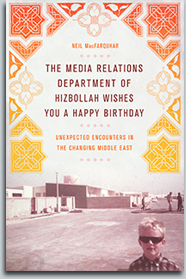
| NEIL MACFARQUHAR'S NEW BOOK: HIZBULLAH WISHES YOU A
HAPPY BIRTHDAY
|
It is not the main theme of Neil MacFarquhar's new book, but it certainly draws immediate attention.
Actually, according to The New York Times' U.N. bureau chief, the title was drawn from a collective wisdom of
friends invited -- and wined and dined -- to make suggestions.
At a book-signing event at the Strand, Neil explained casually that when he worked in Lebanon he had to get
credentials for access to varied active groups and therefore had to fill in forms listing name, date of birth,
email, etc. The Media Relations Department in Hizbollah, which noted these co-ordinates, used to contact him on his
birthday as a public relations gesture.
A subtitle: "Unexpected encounters in the changing Middle East," gave a wider description. Actually, it is an
intelligent, witty and warm personal account of people and places visited while Neil, the professional reporter,
mingled, observed, and reflected human reactions. As an American expatriate, he was brought up in a small town in
Libya. Elated upon returning to that country years later as a distinguished reporter, Neil had to contend with
Qaddafi's ever moody politics. One day the "Brother Leader" decides to change the calendar years, others days he
renames the months. Mostly an erratic style of government operates -- through "Peoples' Committees" that serve as a
front for whatever was on Qaddafi's mind. Sadly, Neil's professional reporting earned him the official censor's
wrath. He was not allowed back "home" despite the most effusive exchange of verbal pleasantries.
Neil had first covered the region for the Associated Press News Agency, including stints in Kuwait and Israel. An
Arabic speaker, he served as The New York Times' bureau chief in Cairo from 2001 to 2005.
As an introduction points out, the Middle East is mostly noted outside its borders for things that go wrong, often
violently. The author, who spent his childhood there, grew accustomed to the sporadic military upheavals -- he was thrilled
to be airlifted out during the Six Day War. But he also knew the region as more than a mere series of grim headlines. He
gradually gained a sense of its rhythms, customs, language, and sly comedy.
As The New York Times' bureau chief, and earlier, as a correspondent for the Associated Press, he reported
for more than thirteen years from cities stretching from Tehran to Marrakech. But in those years his life centered on
the flashpoints of conflict. This book is the story he always wanted to file. It is a warm and wise appreciation of the
Arab world and Iran adjusting to the pressures of modernity and change -- in their distinct way. MacFarquhar shows the
daily lives and attitudes of people frequently obscured behind the curtain of violence: the stories of chefs and sex
therapists, bloggers and academics. He challenges countless assumptions in the West -- that fatwas are all forbidding,
murderous prescriptions, for example. He takes an extensive look at the men and women struggling to reform the
region on their own terms.
Sometimes books of great travel reporting were said to contain a "tour d'horizon." In the Middle East, the horizon
gets lost too often amidst the face of the momentary and sporadic, the instantly catastrophic. MacFarquhar's genius
is to restore the horizon to our understanding of a region that remains critical to the entire world, politically,
culturally, and religiously. A clear vision has never been more needed.
In a somewhat farcical yet clearly affectionate tone, Neil MacFarquhar opens several windows, and some long
closed doors in the traditional societies which he witnessed firsthand. In Saudi Arabic, the notorious "Committee to
Promote Virtue and Prevent Sin" is briefly yet concisely described in a brief incident where a distinguished
professional man and his wife are interrogated while driving in their car because they had been spotted laughing
together. As proof they were married, they had to describe details of their joint home like the shape of their
furniture and the address of their apartment. There is also that anecdote about the
religious scholar behind a widely popular dial-a-sheikh service called The Islamic Line. One caller sought instructions
on how to use a condom while another wondered why precisely is Hashish forbidden. A woman wanted to know, since men
were promised a number of beautiful maidens in paradise, if a woman would be similarly rewarded. One young man
asked if masturbation was a deadly sin; the sheikh counseled avid prayers and lots of sports before marriage.
This is Neil's second book. His first was a novel "The Sand Cafe" about Gulf war correspondents marooned in a
Saudi hotel.
|


