|
DECEMBER 10, 2017
| WOMEN'S RIGHTS ARE HUMAN RIGHTS
|
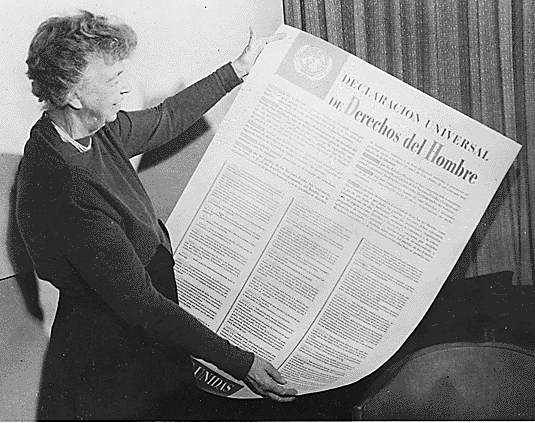
The Anniversary of the Universal Declaration of Human Rights on 10 December this year, at a time when a widening group of women are coming out and standing up against sexual
harassment by once or current powerful men, is an appropriate occasion to assert the role of the international community in stressing that Women's Rights are in fact Human Rights.
It is not
merely an indication of political correctness in certain countries. It is an integral pillar of International Law.
The Declaration, announced 69 years ago at Palais de Chaillot in Paris, was prepared by a team headed by a woman: U.S. First Lady Eleanor Roosevelt with Lebanon's Charles Malek
as its Secretary and French activist Rene Cassin as public advocate. One of the U.N. General Assembly's first Presidents was a woman, Ms. Lakshmi of India. Another early female President
was from Liberia and later from Finland. One of the most active -- and enlightened -- U.N. senior Secretariat officials was Helvi Sipila from Finland, who perplexed certain heads of states
from countries where women were typically disregarded by publicly raising women rights as human rights on their own turf during official visits to their capitals. A world conference
in Mexico City (1975) witnessed a first gathering of prominent active women from official and non-governmental groups from all five Continents.

Mexico City, 1975, UN Photo / B Lane
While women from the U.S. and Europe sought to stress their right of adequate representation in national bodies, and those from developing countries, particularly needy ones,
focused on the right to have access to clean water, appropriate medical aid, and available education, they joined together to stress opposition to sexual harassment, unfair social
handling and the need to share a joint solid position.

Nairobi, 1985, UN Photo / Milton Grant
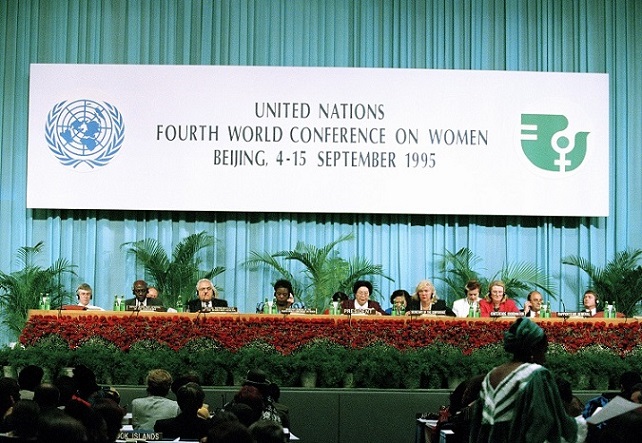
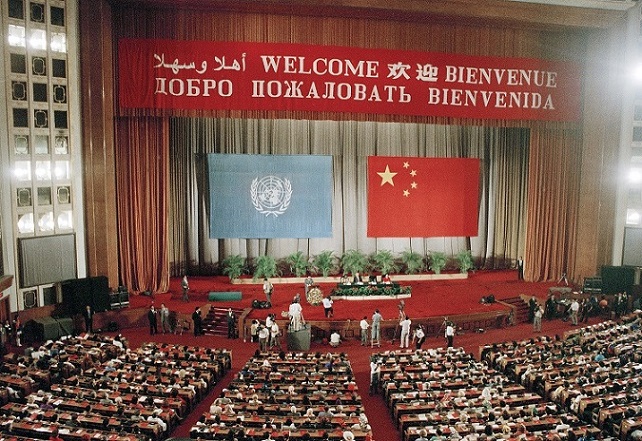
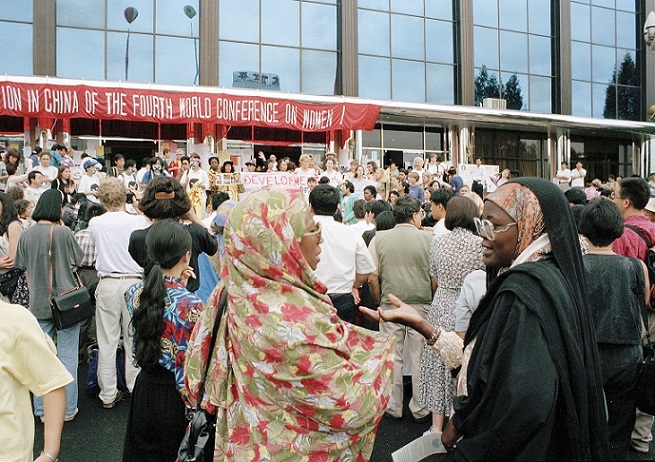
Ten years later (1985), the World Conference to Review and Appraise the Achievements of the UN Decade for Women was held in Nairobi, Kenya, followed by the Fourth World Conference on
Women
in Beijing (1995), where an official declaration stressed -- for the record and future
generations -- that Women's Rights are Human Rights. This marked a significant turning point for the global agenda for gender equality. The Beijing Declaration and the
Platform for Action adopted unanimously by 189 countries, was an agenda for women’s empowerment and considered the key global policy document on gender equality.
It was followed later in that year by a gathering of senior national and international women, including female heads of
state and First Ladies, at U.N. Headquarters in New York, coordinated by a man, Samir Sanbar, then Assistant Secretary-General for Public Information.
A further conference in 2005, attended by almost all First Ladies and female Heads of State, was hosted by U.N. Secretary-General Kofi Annan.
While, regrettably, the occasion passed in 2015 like any other day -- similar to ceremonies about Mountains, Traffic or Toilets -- there was little indication as to the
extent of preparations for this year. It is now up to a new Secretary-General and his team of new senior officials -- many of whom, by the way are women -- to extend or limit
the commemoration of such a valuable occasion of special international interest and such current public relevance.
Anyway, looking forward, it will have particular impact and gain wider popular participation if preparations start now to mobilize for the 70th anniversary next year,
on 10 December 2018. Launching a historical conference from Chateau de Chaillot, with the participation of the High Commissioner for Human Rights (a man), Director General of UNESCO
in Paris (a woman), the President of France, together with other heads of state, and hopefully the U.N. Secretary-General will require enlightened efficient efforts starting
immediately by everyone.
It will also be a landmark opportunity -- a crucial one -- to highlight for governments and public opinion everywhere the practical relevance of Human Rights = Women's Rights. It's the
right thing to do.
|


