|
15 SEPTEMBER 2012
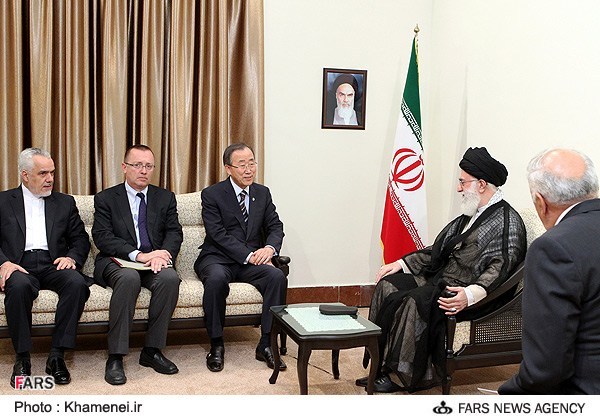
A visit by U.N. Secretary General Ban Ki-moon to Iran for a Non-Aligned Conference was publicly opposed by the governments of the United States
and Israel. Yet his travelling team included Jeffrey Feltman, newly-appointed U.N. Under-Secretary General for Political Affairs who until recently
was U.S. Assistant Secretary of State for Near East Affairs and Terje Roed-Larsen, the closest U.N. Envoy to Israeli President Shimon Peres since
the Oslo Accord who has also developed close relations with oil rich Gulf countries, especially Saudi Arabia. Whether it was a shrewdly calculated
decision or an imposed move, it must have been a substantial learning experience. Ambassador Feltman had devoted considerable energy for years
since 2006 in Beirut to mobilize against Hezbollah. A photo in a Teheran daily between Supreme Guide Ayatollah Khamenei and National Security
Chief Jalili did not convey his habitually jolly side. Larsen was kept totally out of the picture. Their mere presence was perceived by Iranian
officials, adept at bargaining, as welcome conduits to explore potential backchannels. Although the former American diplomat is now an international
official, he would require approval as a citizen from his former office at State where he naturally maintains contact.
Ban Ki-moon's notes on his meetings indicated that he raised all the expected issues: nuclear controls, human rights in treating dissidents, decrying
the denial of the Holocaust, stressing Israel's right to exist, developments in Afghanistan, Iraq and, of course, Syria. Having served as a Korean
diplomat there in 1974 (during the Shah's regime), he rightly recalled "Iran's very colourful civilization and culture." In taking the Chairmanship
of the Non-Aligned Movement, consisting 2/3 of U.N. membership, Iran has an opportunity, Mr. Ban urged, to play "a very moderate and constructive
role working together with U.N. members in addressing many global and regional challenges." While all these issues, as diplomats say, will be
appropriately pursued, the real deal, if any, would be on Syria.
With the end of Kofi Annan's mission, and a start of another by Lakhdar Brahimi, the nuanced rhetoric by Ban Ki-moon has positively shifted. He is
now stressing that "there is no alternative to peaceful diplomatic settlement based on reciprocity." Iran, a solid supporter of the current regime,
indicated that it would propose "a convincing and reasonable settlement." That means an opening bid to salvage whatever is feasible for its close
ally as a prelude to tough bargaining, inch by every agonizing inch. The new President of Egypt Mohammed Morsi who stated that Assad must go, proposed
a forum with three other regional governments: Iran, Turkey, and Saudi Arabia. Yet there are forces even within these countries interested in
escalating rather than controlling the conflict. There are others like Qatar, which has been very active so far; France, whose new President is keen
on making a mark in a former French mandated territory, and a rhetorically active yet actively ponderous U.S. Administration. If -- and it's a big
if -- a generally agreed arrangement evolves, a joint Arab League/U.N. Envoy would try, with wider consultation to draw a face-saving deal and try to
pass it through the Security Council. That's unlikely before November. Meanwhile, the main victim remains the innocent, creative and decent Syrian
people, a dignified multi-cultural survivor of at least three thousand years of human history.
|


